
Benjamin Netanyahu, widely known as Bibi, has maintained a firm grip on Israel’s leadership for decades, serving as prime minister from 1996 to 1999 and again from 2009 through March 2025—over 15 years in his latest tenure, the longest of any Israeli prime minister. His political rise began with a story familiar to many Americans: in 1976, his brother Yoni was killed during a raid at Entebbe Airport in Uganda, where Israeli commandos rescued over 100 hostages from a plane hijacked by Palestinian militants. Netanyahu capitalized on this tragedy, appearing on U.S. television in the 1980s and 1990s as a self-proclaimed terrorism expert, ascending to Israel’s premiership by age 46. Less acknowledged, however, is how his prolonged leadership has entangled the United States in a costly web of corruption and instability.

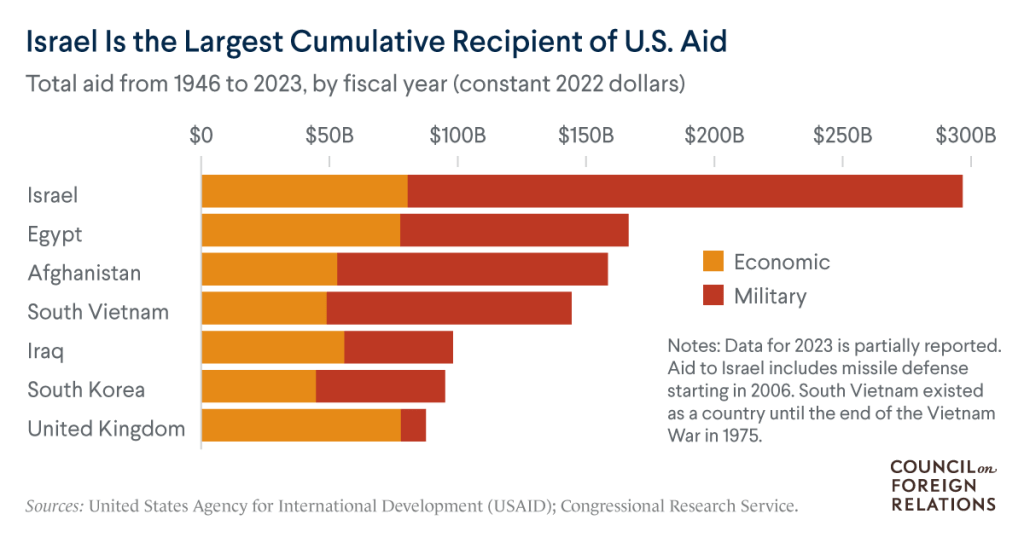
The United States provides significant financial support to Israel, disbursing $3.8 billion in 2024 alone under a 2016 agreement that commits billions annually through 2028, primarily for military aid. This constitutes a substantial portion of U.S. foreign aid spending. Yet, under Netanyahu’s stewardship, allegations of corruption—including bribery, fraud, and breach of trust—have followed him for years, intensifying the burden on American resources. These issues transcend Israel’s borders, drawing the United States into a series of scandals and conflicts that demand diplomatic and financial attention.
Consider Arnon Milchan, an Israeli Hollywood producer behind films like Pretty Woman and Fight Club, who prosecutors allege supplied Netanyahu and his wife, Sara, with approximately $250,000 in gifts—cigars, champagne, and jewelry—over several years. Netanyahu’s associates dismiss these as benign exchanges, but the implications for the U.S. are significant. Reports suggest he pressed then-U.S. Secretary of State John Kerry (2013–2017) to secure Milchan’s American visa after it was revoked due to past arms-dealing allegations. Although no court has confirmed bribery as of March 2025, the ongoing trial consumes U.S. time and taxpayer resources on Israel’s internal controversies.
Another case involves Shaul Elovitch, former owner of Bezeq, Israel’s leading telecommunications company, and its news outlet, Walla, where in 2016, facing billions in debt, he secured government approval from Netanyahu to access $200 million in funds, followed by Walla publishing hundreds of favorable articles about him, corroborated by text messages from a former employee. Both Elovitch and Netanyahu deny any quid pro quo, yet this incident underscores concerns about the integrity of Israel’s leadership—leadership partly sustained by the $3.8 billion in annual U.S. aid.
Netanyahu’s family further complicates matters, with Sara Netanyahu fined $42,000 in 2019 after a court ruled she mistreated staff at the prime minister’s residence, with documented instances of verbal abuse and property damage. Reports indicate she influences her husband’s political appointments and enjoys the lavish gifts linked to his corruption cases. Their son, Yair, frequently shares far-right rhetoric online, and Netanyahu has publicly suggested him as a potential successor. While no definitive evidence proves their control over policy, the family’s actions portray Israel as a personal enterprise rather than a reliable ally, dependent on U.S. financial support.
Israel’s legal turmoil reached a climax in 2019 when Netanyahu became the first sitting prime minister charged with bribery, fraud, and breach of trust. In 2023, he advocated a judicial overhaul to curb court oversight, presented as reform, though critics argue it was an evasion of his legal challenges, prompting mass protests with tens of thousands flooding Tel Aviv’s streets. Then, on October 7, 2023, Hamas—a Palestinian militant group controlling Gaza—attacked Israel, killing 1,200 people and taking hostages. Bank records show Netanyahu allowed Qatar to send $35 million monthly to Hamas, funds that enhanced their capabilities. He denies this precipitated the attack, but the resulting war prompted an additional $17 billion in U.S. aid since 2023, heightening American military involvement in the region.

In 2024, Netanyahu addressed the U.S. Congress, receiving a warm reception, yet the underlying realities remain sobering. Israel has become a financial and strategic liability for the U.S., marked by Milchan’s $250,000 in gifts, Elovitch’s allegedly manipulated news coverage, and a war intensified by questionable policies—all tied to Netanyahu’s tenure. His trial remains unresolved as of March 2025, and he denies all charges. Nevertheless, the financial toll is clear: $3.8 billion annually, plus $17 billion since the 2023 attack. Israel’s scandals siphon American resources, focus, and security, offering little in return but persistent instability. The U.S. merits a partnership that delivers value, not one mired in corruption and conflict.
 usafirstnews.org
Leave a comment